
Friday, August 24, 2012

Thursday, August 23, 2012
Chinese Social Media: What You Need to Know
More often than not, the place with the greatest potential to learn is where you'd least expect it. And with a field like social media that thrives on freedom of speech, there is no place more apt for study than China.
 Not nearly as well-documented as Twitter or Facebook due to China's closed-door policy, Chinese social networks may very well hold the future of social media due to their significant size and sheer consuming power. The difficult part however is the differences in content-sharing.
Strength in Numbers
According to The Realtime Report as of April 6, 2012 just between China's top three social networks (Tencent's Qzone, Sina Weibo and Renren) there are over 970 million profiles--that's over three times the population of the United States. And these profiles are more active than any other country.
According to a survey from McKinsey & Company, 91 percent of Chinese correspondents said they visited a social media site in the last sixth months, a question that only resulted in 67 percent in the United States and 30 percent in Japan.
Content Sharing
Due to government censorship, the Chinese people hold a significant distrust of large institutions. Instead, word-of-mouth and in turn social media, have taken the lead as public authority. But since even social media are monitored in China--and topics such as politics or world events are kept at bay--consumer gossip and viral media run rampant.
In a study from HP Labs in Palo Alto, California this difference is compared between China's Sina Weibo and Twitter. They found trends exclusively follow media content surrounding jokes, images and videos while Twitter revolves more around world events and news stories.
This could prove beneficial for social media platforms but difficult for advertisers. It would not be outlandish to suspect new more underhanded methods of advertising to be on the horizon as advertisers try to distance themselves from their institutional persona. Needless to say the platforms will want to pander to these deep-pockets as well but if it is similiar to what we are beginning to see from Facebook we know public opinion can shift quick if privacy expectations are not met.
Fortunately there is one constant that crosses all social media studies--the desire to connect. From China's enthusiasm for online dating to their high mobile population, they echo the same emphasis on connectedness and outreach found in every wired country. The only question is how and when that potential goes worldwide.
The Networks to Watch
Mashable lists the top five Chinese social networks to watch.
1. Sina Weibo
This microblog platform houses more than 22% of the online Chinese population and is a major driver in social discourse and consumer activity.
2. Renren
A profile network more similar to Facebook, it began like its American cousin thriving with students and is now branching out to over 147 million users.
3. Tencent
Built on the QQ Instant Messaging service, this platform uses multiple platforms to house the largest Chinese community in terms of sheer registered users. Responsible for Qzone where over 500 million users write blogs and share pictures and music.
4. Douban
A bit more high brow for those inclined to review movies, music and books, Douban's strengths lie in their open format allowing 80% of all site content to be available for non-registered users and their high volume of 80 million registered users per month.
5. Wechat
More than 69% of the Chinese population accesses the Internet from a mobile device. That makes this voice and text app with constantly growing features a platform to watch in the war for Chinese mobile.

Strength in Numbers
According to The Realtime Report as of April 6, 2012 just between China's top three social networks (Tencent's Qzone, Sina Weibo and Renren) there are over 970 million profiles--that's over three times the population of the United States. And these profiles are more active than any other country.
According to a survey from McKinsey & Company, 91 percent of Chinese correspondents said they visited a social media site in the last sixth months, a question that only resulted in 67 percent in the United States and 30 percent in Japan.
Content Sharing
Due to government censorship, the Chinese people hold a significant distrust of large institutions. Instead, word-of-mouth and in turn social media, have taken the lead as public authority. But since even social media are monitored in China--and topics such as politics or world events are kept at bay--consumer gossip and viral media run rampant.
In a study from HP Labs in Palo Alto, California this difference is compared between China's Sina Weibo and Twitter. They found trends exclusively follow media content surrounding jokes, images and videos while Twitter revolves more around world events and news stories.
This could prove beneficial for social media platforms but difficult for advertisers. It would not be outlandish to suspect new more underhanded methods of advertising to be on the horizon as advertisers try to distance themselves from their institutional persona. Needless to say the platforms will want to pander to these deep-pockets as well but if it is similiar to what we are beginning to see from Facebook we know public opinion can shift quick if privacy expectations are not met.
Fortunately there is one constant that crosses all social media studies--the desire to connect. From China's enthusiasm for online dating to their high mobile population, they echo the same emphasis on connectedness and outreach found in every wired country. The only question is how and when that potential goes worldwide.
The Networks to Watch
Mashable lists the top five Chinese social networks to watch.
1. Sina Weibo
This microblog platform houses more than 22% of the online Chinese population and is a major driver in social discourse and consumer activity.
2. Renren
A profile network more similar to Facebook, it began like its American cousin thriving with students and is now branching out to over 147 million users.
3. Tencent
Built on the QQ Instant Messaging service, this platform uses multiple platforms to house the largest Chinese community in terms of sheer registered users. Responsible for Qzone where over 500 million users write blogs and share pictures and music.
4. Douban
A bit more high brow for those inclined to review movies, music and books, Douban's strengths lie in their open format allowing 80% of all site content to be available for non-registered users and their high volume of 80 million registered users per month.
5. Wechat
More than 69% of the Chinese population accesses the Internet from a mobile device. That makes this voice and text app with constantly growing features a platform to watch in the war for Chinese mobile.
Wednesday, August 22, 2012

Monday, August 20, 2012
What It Means to Have Klout
"What is your Klout score?" This could very likely be an interview question asked by your next potential employer. While the San Francisco start-up that measures social media influence has been heavily criticized by public personas such as President Barack Obama to American author John Scalzi, it is becoming a new qualification for those working in marketing and social media.
What is Klout?
Klout is a application built to measure a person's influence across all social media platforms. Currently including Twitter, Facebook, LinkedIn, Google+, Foursquare, YouTube, Instagram, Blogger, Tumblr, WordPress, Last.fm and Flickr, it compiles all posts, comments and shares into an algorithm that gives you a score from 1 to 100. And if you work in social media, you better hope you land somewhere toward the top.
In an article from Wired, they tell the story of Sam Florella--a fifteen-year consultant who had worked with major brands such as AOL, Ford and Kraft. During his interview at a large Toronto marketing agency they requested his Klout score. He admitted he didn't know what that even was. So, they pulled up the website and discovered across his social networks he had a Klout score of 34. The interview didn't last long after that.

Klout is also being used by retailers. According that same article from Wired, the Palms Casino Resort in Las Vegas had clerks look up customer's Klout scores upon check in last summer and high scorers received instant upgrades. After the so called "Klout experiment" the Palms went from being 17th-largest in social networking among Las Vegas casinos to third on Facebook and one of the highest among Klout users.
And this is just the beginning. In February, Salesforce.com introduced a service to monitor client Klout scores. A service that undoubtedly could result in quicker and more personal attention to those with higher social media presence.
Criticisms
As mentioned before, Klout is not without its critics. Not only for the method of breaking down complex online networks into one simple number but also for its societal effect. By quantifying these interactions many consider it a devaluation of human interaction. British author Charles Stross in his blog calls Klout "the Internet equivelant of herpes." Another author, this time American John Scalzi, considers Klout to be "socially evil."
While quantifying someone's influence may seem a bit barbaric, it is the business of measurable social media. And this business pays. In many ways Klout is merely identifying people we already knew to exist--opinion leaders--and the easier to find them, the easier to use them (or become them). So quit tweaking with your resume and open a browser. It's time to check your Klout score.
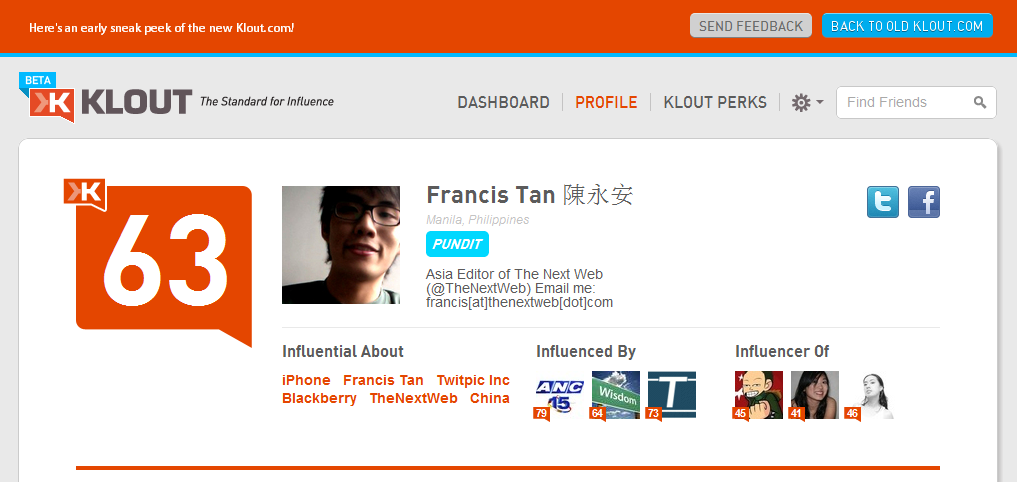
Klout is also being used by retailers. According that same article from Wired, the Palms Casino Resort in Las Vegas had clerks look up customer's Klout scores upon check in last summer and high scorers received instant upgrades. After the so called "Klout experiment" the Palms went from being 17th-largest in social networking among Las Vegas casinos to third on Facebook and one of the highest among Klout users.
And this is just the beginning. In February, Salesforce.com introduced a service to monitor client Klout scores. A service that undoubtedly could result in quicker and more personal attention to those with higher social media presence.
Criticisms
As mentioned before, Klout is not without its critics. Not only for the method of breaking down complex online networks into one simple number but also for its societal effect. By quantifying these interactions many consider it a devaluation of human interaction. British author Charles Stross in his blog calls Klout "the Internet equivelant of herpes." Another author, this time American John Scalzi, considers Klout to be "socially evil."
While quantifying someone's influence may seem a bit barbaric, it is the business of measurable social media. And this business pays. In many ways Klout is merely identifying people we already knew to exist--opinion leaders--and the easier to find them, the easier to use them (or become them). So quit tweaking with your resume and open a browser. It's time to check your Klout score.
Thursday, August 9, 2012
The Benefits of Bilinguals in Advertising
Curious as to what other professionals had to say about the importance of learning another language, I asked this question to a pool of copywriters and social media marketers:
"As a copywriter, how important is it to you to learn another language? And if you do know another language, do you often market it to potential employers?"
Here are their responses.
Alex, copywriter in Miami, United States
In my experience, learning a second language taught me a lot about the first, and gave me a lot of access to information that's not available otherwise. Also, there is several types of copywriting work that involve translation or transcreation (which is what I do on a daily basis). Nowadays, it's very common to create sites, web campaigns and content for more than one market, or language, and specially for freelancers.
So, depending on your clients, it would be a really good added value to have more than one language in your portfolio of services.
Nick, independent editing professional in London, United Kingdom
I speak fluent French, would never attempt to write copy in French, but I have frequently been asked to take a translated piece, look at the original French and put the English version into better 'copy', which often means finding a way of saying something that accurately reflects the original writers intention but which cannot be literally translated.
Jill, copywriter in Sydney, Australia
I have a degree in French, then a career in marketing before specialising in copywriting. Studying another language gives you much greater insight into how your own language is constructed. I would never try to write copy in French but would love the opportunity to create English copy from a French text. Travel overseas also broadens your perspective on life which is always handy as a copywriter.
Sean, copywriter in London, United Kingdom
I wouldn't say it is essential but it certainly is beneficial and can reap many rewards, not to mention quality of life personally. Like other answers have said, learning Italian taught me a lot about how English everyday mannerisms in London had gotten in the way of communicating a clear, direct message. Learning a second, third or fourth language had a very odd way of increasing your appreciation for your mother-tongue!
"As a copywriter, how important is it to you to learn another language? And if you do know another language, do you often market it to potential employers?"
Here are their responses.
Alex, copywriter in Miami, United States
In my experience, learning a second language taught me a lot about the first, and gave me a lot of access to information that's not available otherwise. Also, there is several types of copywriting work that involve translation or transcreation (which is what I do on a daily basis). Nowadays, it's very common to create sites, web campaigns and content for more than one market, or language, and specially for freelancers.
So, depending on your clients, it would be a really good added value to have more than one language in your portfolio of services.
Nick, independent editing professional in London, United Kingdom
I speak fluent French, would never attempt to write copy in French, but I have frequently been asked to take a translated piece, look at the original French and put the English version into better 'copy', which often means finding a way of saying something that accurately reflects the original writers intention but which cannot be literally translated.
Jill, copywriter in Sydney, Australia
I have a degree in French, then a career in marketing before specialising in copywriting. Studying another language gives you much greater insight into how your own language is constructed. I would never try to write copy in French but would love the opportunity to create English copy from a French text. Travel overseas also broadens your perspective on life which is always handy as a copywriter.
Sean, copywriter in London, United Kingdom
I wouldn't say it is essential but it certainly is beneficial and can reap many rewards, not to mention quality of life personally. Like other answers have said, learning Italian taught me a lot about how English everyday mannerisms in London had gotten in the way of communicating a clear, direct message. Learning a second, third or fourth language had a very odd way of increasing your appreciation for your mother-tongue!
Monday, August 6, 2012
The Death of SEO and the Rise of Quality Content
While an important component of any marketing campaign, Search Engine Optimization has long felt like catching bees with honey.
As the initial step in a growth cycle it makes sense that search engines assumed keywords linked to relevant content. Unfortunately this idea has become saturated with advertisers using black-hat techniques to cloak their lack of content with repetitive phrasing and blatant link schemes. In the past Google has taken a hole-patching approach with updates called Panda to down-rank websites that downgraded user experience. If this doesn't sound innovative enough to be Google, you'd be correct because it turns out they were just buying time.

With the Google Penguin release announced in April 2012, the concept of SEO as becoming obsolete was confirmed. Search engines are getting smarter and their algorithms more complex. Keywords will no doubt remain an important asset but the Penguin release marks an important shift in perspective marketers from cheating the system to producing quality content.
So how does this new algorithm work? In Forbes, Ken Krogue puts it best.
"Google used to think if you linked to someone on the Internet they must have valuable content. Now Google seems to believe that if you promote content with social media it is more indicative of relevant content and less likely to be faked."
While this may simply lead may SEO specialists to become social media strategists it shifts new importance on social media platforms. And with social media platforms users are given more opportunity to filter and react to marketing strategies. So what is a marketer to do? Engage with quality content.
You may be able to fake content but you can't fake shares (at least not easily). Twitter and Facebook may have their fair share of fake accounts but like Google, their digital czars are getting better and better at zapping them out of existence.
And to get shared you have to be relevant, or at least interesting. In the same article by Krogue in Forbes he gives an excellent list of "14 Approaches for Generating Real Content."
1) Research important questions.
2) List good/bad examples.
3) Passionately tell a story.
4) Highlight recent trends.
5) Survey best practices.
6) Compile prove tips.
7) Point out a problem.
8) Recognize who.
9) List what.
10) Warn when.
11) Show where.
12) Debate why.
13) Demonstrate how.
14) State the so what.
In conclusion, the death of gaming the system has been marked. So choose your writers carefully, it's time to get real.
As the initial step in a growth cycle it makes sense that search engines assumed keywords linked to relevant content. Unfortunately this idea has become saturated with advertisers using black-hat techniques to cloak their lack of content with repetitive phrasing and blatant link schemes. In the past Google has taken a hole-patching approach with updates called Panda to down-rank websites that downgraded user experience. If this doesn't sound innovative enough to be Google, you'd be correct because it turns out they were just buying time.

The Google Penguin Release
With the Google Penguin release announced in April 2012, the concept of SEO as becoming obsolete was confirmed. Search engines are getting smarter and their algorithms more complex. Keywords will no doubt remain an important asset but the Penguin release marks an important shift in perspective marketers from cheating the system to producing quality content.
So how does this new algorithm work? In Forbes, Ken Krogue puts it best.
"Google used to think if you linked to someone on the Internet they must have valuable content. Now Google seems to believe that if you promote content with social media it is more indicative of relevant content and less likely to be faked."
While this may simply lead may SEO specialists to become social media strategists it shifts new importance on social media platforms. And with social media platforms users are given more opportunity to filter and react to marketing strategies. So what is a marketer to do? Engage with quality content.
Content is King and the Metrics of Engagement
You may be able to fake content but you can't fake shares (at least not easily). Twitter and Facebook may have their fair share of fake accounts but like Google, their digital czars are getting better and better at zapping them out of existence.
And to get shared you have to be relevant, or at least interesting. In the same article by Krogue in Forbes he gives an excellent list of "14 Approaches for Generating Real Content."
1) Research important questions.
2) List good/bad examples.
3) Passionately tell a story.
4) Highlight recent trends.
5) Survey best practices.
6) Compile prove tips.
7) Point out a problem.
8) Recognize who.
9) List what.
10) Warn when.
11) Show where.
12) Debate why.
13) Demonstrate how.
14) State the so what.
In conclusion, the death of gaming the system has been marked. So choose your writers carefully, it's time to get real.
Friday, August 3, 2012

Subscribe to:
Posts (Atom)